


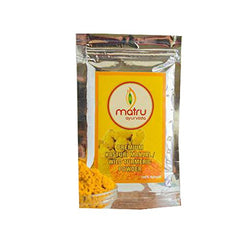
Kasturi Haldi Powder — Pure Wild Turmeric for Glowing Skin, Acne, Tan Removal & Ubtan | Matru Ayurveda
- Rs. 225.00
- Rs. 225.00
- Unit price
- per
There is a reason every South Indian bride's pre-wedding ceremony begins with one ingredient. Kasturi Haldi — also called Kasturi Manjal in Tamil, wild turmeric, and Curcuma aromatica in Ayurvedic texts — is not your kitchen turmeric. It is a rare wild species, harvested from the forests and farms of the Western Ghats, prized for centuries in...
10 customers are viewing this product
Couldn't load pickup availability
Free Shipping
Free standard shipping on orders over 499
Delivery in 3-7 days

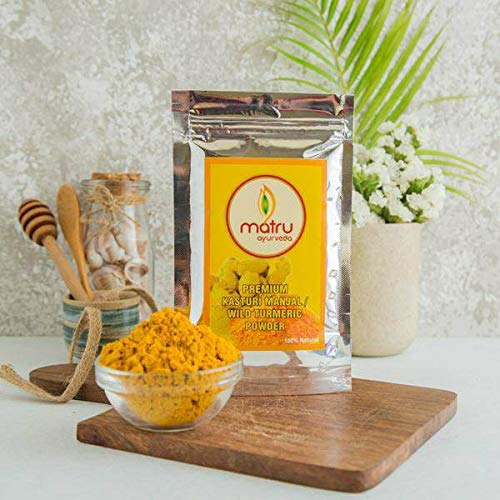
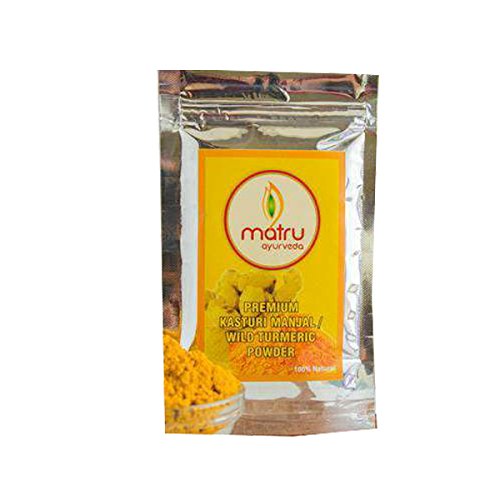
There is a reason every South Indian bride's pre-wedding ceremony begins with one ingredient. Kasturi Haldi — also called Kasturi Manjal in Tamil, wild turmeric, and Curcuma aromatica in Ayurvedic texts — is not your kitchen turmeric. It is a rare wild species, harvested from the forests and farms of the Western Ghats, prized for centuries in Ayurvedic skin care because it does everything regular turmeric does for the skin — brightening, anti-inflammatory, antibacterial, anti-ageing — without leaving any yellow stain on the skin. Matru Ayurveda's 100% pure Kasturi Haldi powder is stone-ground from shade-dried wild turmeric rhizomes with no additives, no preservatives, and no chemical processing of any kind. This is Ayurveda's most celebrated beauty herb, exactly as it has been used for five thousand years.
Why Kasturi Haldi is completely different from kitchen turmeric
The turmeric in your kitchen is Curcuma longa — high in curcumin, intensely yellow, and known to stain skin, nails, and fabric for days. Kasturi Haldi is Curcuma aromatica — a wild relative from a completely different species. The differences matter enormously for skin care:
- Does not stain — Kasturi Haldi has a much lower curcumin content than kitchen turmeric, which is responsible for the yellow staining. You can use Kasturi Haldi as a face pack and go out immediately after — no yellow tinge, no orange palms, no stained towels.
- Camphor-musk fragrance — Kasturi Haldi gets its name from its distinctive musk-like aroma (Kasturi means musk in Sanskrit). Unlike kitchen turmeric's sharp, pungent smell, Kasturi Haldi has a subtle, camphor-like fragrance — earthy, clean, and pleasant on the skin.
- Cooling sensation — Where kitchen turmeric can feel warming or occasionally irritating on sensitive skin, Kasturi Haldi imparts a gentle cooling sensation on application — calming inflamed, acne-prone, or irritated skin rather than aggravating it.
- Higher aromatic compound concentration — Kasturi Haldi contains higher concentrations of zingiberene, sesquiterpenes, and germacrone — the aromatic compounds responsible for its superior anti-inflammatory and skin-brightening action. This is why it is classified in classical Ayurvedic texts as a Varnya Dravya — a complexion-enhancing herb — while kitchen turmeric is not.
- Safe for sensitive and baby skin — Its cooling, non-staining, gentle nature makes Kasturi Haldi safe for sensitive skin types that cannot tolerate regular turmeric. It has traditionally been used for bathing newborns in South India for its antiseptic and skin-nourishing properties.
How to use — five face pack recipes for different skin needs
Mix 1–2 teaspoons of Kasturi Haldi powder with your chosen liquid or base to form a smooth, lump-free paste. Apply evenly to the face and neck, avoiding the eye area. Leave for 10–15 minutes. Rinse off with plain water and pat dry with a soft cloth. Use 2–3 times per week for consistent results.
🌿 For glowing skin — the classic recipe
Mix Kasturi Haldi with rose water into a smooth paste. The rose water calms the skin while the Kasturi Haldi brightens it. Ideal for normal, dry, and combination skin types. This is the most traditional Haldi beauty recipe — simple, gentle, and effective.
🥛 For acne, acne scars, and oily skin — curd base
Mix Kasturi Haldi with plain curd (dahi). The lactic acid in curd gently exfoliates and brightens, while Kasturi Haldi's antibacterial action fights acne-causing bacteria. This combination is particularly effective for oily, acne-prone, and blemish-prone skin — reducing both active breakouts and post-acne dark marks.
🍯 For dry, dull, or mature skin — honey base
Mix Kasturi Haldi with raw honey. Honey is a natural humectant that draws moisture into the skin and has its own antibacterial properties. Together with Kasturi Haldi's antioxidants, this combination is deeply nourishing, brightening, and anti-ageing — ideal for dry, dull, or maturing skin that needs both glow and hydration.
🍵 For tan removal and pigmentation — raw milk
Mix Kasturi Haldi with raw, unboiled milk. The lactic acid in raw milk works synergistically with Kasturi Haldi's melanin-inhibiting compounds to address both fresh and longstanding tan, uneven skin tone, and pigmentation patches. Apply to tanned areas on the face, neck, and body. One of the most effective traditional de-tanning treatments in Ayurveda.
🫒 For facial hair reduction — warm oil base
Mix Kasturi Haldi with a small amount of warm coconut oil or almond oil to form a thick paste. Apply to areas with fine facial hair, rubbing gently in the direction of hair growth. Leave for 15 minutes and rinse. Consistent use over 4–6 weeks is traditionally associated with gradual reduction of fine facial hair.
Tip: Store the powder in a cool, dry place away from moisture. Always use a dry spoon to take out the powder — any moisture introduced into the jar can reduce its shelf life.
What Kasturi Haldi does for your skin
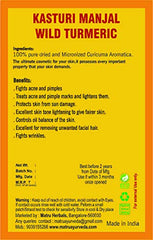
- Delivers a natural, healthy glow — Kasturi Haldi improves skin radiance by gently stimulating micro-circulation, removing dead skin cells, and brightening the overall complexion. The glow is not artificial — it is the result of genuinely healthier, better-nourished skin. This is its most traditional and most celebrated use in Indian beauty culture.
- Treats acne and prevents breakouts — The antibacterial compounds in Kasturi Haldi actively combat the bacteria responsible for acne and pimples (Propionibacterium acnes). Its anti-inflammatory action simultaneously reduces the redness and swelling around active breakouts. Unlike harsh chemical acne treatments, it does this without stripping the skin's natural moisture — making it suitable for both oily and combination skin types.
- Fades acne scars and blemishes — Regular use of Kasturi Haldi face packs gradually reduces the post-inflammatory hyperpigmentation left behind by acne — the dark spots and uneven patches that persist long after the breakout itself has healed. This is a result of its antioxidant action on melanin production in the affected skin cells.
- Removes sun tan and reverses UV damage — Kasturi Haldi addresses the excess melanin production triggered by UV exposure — the direct cause of tanning. Used as a face or body pack consistently, it visibly lightens sun-tanned areas within 2–3 weeks and helps restore the skin's natural tone.
- Reduces dark spots and pigmentation — The antioxidant compounds in Kasturi Haldi inhibit tyrosinase — the enzyme responsible for melanin synthesis. This reduces the production of new pigmentation and gradually fades existing dark spots, uneven patches, and areas of hyperpigmentation over consistent use.
- Delays signs of skin ageing — Free radical damage is one of the primary drivers of premature skin ageing. Kasturi Haldi's high antioxidant content neutralises these free radicals, reducing the breakdown of collagen and elastin that leads to fine lines and loss of skin firmness. Traditional Ayurvedic texts recommend it for maintaining youthful skin well into later years.
- Unclogs pores and refines skin texture — Kasturi Haldi's fine powder acts as a gentle physical exfoliant when mixed into a paste, removing the accumulated dead skin cells, sebum, and environmental pollutants that clog pores and give skin a dull, rough texture. Regular use visibly refines and smoothens the skin's surface.
- Soothes inflamed and sensitive skin — Its anti-inflammatory properties make it highly effective for soothing chronically inflamed skin — rosacea, eczema-prone areas, heat rash, and irritation caused by pollution or harsh skincare products. The cooling sensation on application provides immediate comfort.
- Reduces unwanted facial hair over time — One of Kasturi Haldi's most traditional uses, particularly in South India, is gradual reduction of fine facial hair with regular use. Mixed with warm oil and used consistently over 4–6 weeks, it is traditionally said to inhibit hair follicle growth at the surface — a completely natural and gentle alternative to chemical depilation.
- Safe for use as a body powder and bath ritual — In South Indian tradition, Kasturi Haldi is applied to the entire body before bathing — a practice known as Nalungu — to cleanse the skin, remove body odour-causing bacteria, and leave the skin soft and fragrant. This is particularly traditional before festivals, weddings, and after childbirth.
Product details
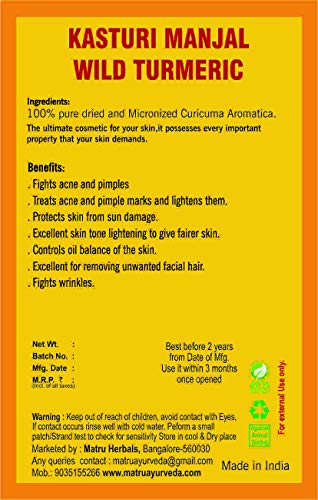
- Ingredients: 100% Curcuma Aromatica (Wild Turmeric / Kasturi Haldi) rhizome powder — nothing else
- Also known as: Kasturi Manjal (Tamil), Amba Haldi (Hindi/Marathi), Vana Haridra (Sanskrit), Adavi Pasupu (Telugu), Kastoori Arishina (Kannada), Musk Turmeric, Wild Turmeric
- Net weight: 100g
- Shelf life: 24 months from date of manufacture
- Storage: Store in a cool, dry place. Keep the jar tightly closed. Use a dry spoon — moisture reduces shelf life
- Suitable for: All skin types including sensitive, oily, acne-prone, combination, and mature skin. Safe for all ages for external use
- Free from: Synthetic colour, artificial fragrance, chemical preservatives, bleaching agents, additives, fillers
- For external use only
Related Products
Example product title
- Rs. 225.00
- Rs. 225.00
- Unit price
- per
Example product title
- Rs. 225.00
- Rs. 225.00
- Unit price
- per
Example product title
- Rs. 225.00
- Rs. 225.00
- Unit price
- per
Example product title
- Rs. 225.00
- Rs. 225.00
- Unit price
- per
Example product title
- Rs. 225.00
- Rs. 225.00
- Unit price
- per
Example product title
- Rs. 225.00
- Rs. 225.00
- Unit price
- per
Recently Viewed Products
Example product title
- Rs. 225.00
- Rs. 225.00
- Unit price
- per
Example product title
- Rs. 225.00
- Rs. 225.00
- Unit price
- per
Example product title
- Rs. 225.00
- Rs. 225.00
- Unit price
- per
Example product title
- Rs. 225.00
- Rs. 225.00
- Unit price
- per
Example product title
- Rs. 225.00
- Rs. 225.00
- Unit price
- per
Example product title
- Rs. 225.00
- Rs. 225.00
- Unit price
- per
Example product title
- Rs. 225.00
- Rs. 225.00
- Unit price
- per
Example product title
- Rs. 225.00
- Rs. 225.00
- Unit price
- per
Example product title
- Rs. 225.00
- Rs. 225.00
- Unit price
- per
Example product title
- Rs. 225.00
- Rs. 225.00
- Unit price
- per
- Choosing a selection results in a full page refresh.